
What is Patient-Specific Knee Replacement?
If knee arthritis is affecting your ability to walk, climb stairs, sleep, work or enjoy activities from pain or stiffness, book in with your GP to discuss.
These kinds of circumstances can have a direct impact on your quality of life, and because of this, your GP will arrange imaging to see how much joint damage is present and may provide a referral for specialist opinion.
If your GP is arranging X-rays or has advised you that your knee arthritis has progressed, request a referral to Dr David Kitchen, Adelaide-based Orthopaedic Specialist. Dr Kitchen will review your symptoms, imaging, knee structure and activity goals to find the treatment option that fits your knee, including patient-specific knee replacement if suitable.
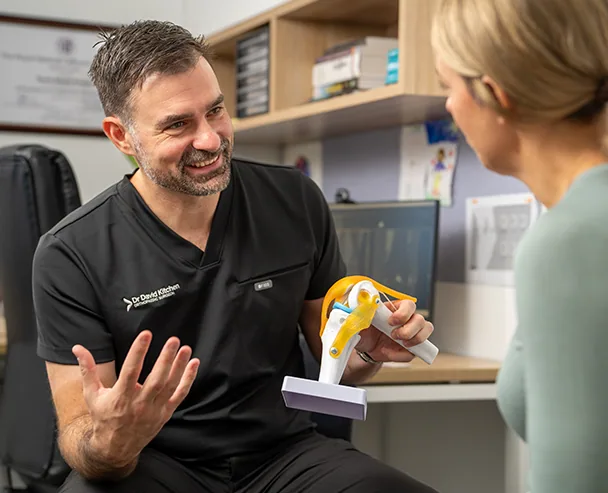
What does patient-specific knee replacement mean?
Standard knee replacement implants are made in a range of sizes and shapes, and for the majority of patients, a well-selected implant performs very well. But no two knees are exactly the same. Bone shape, alignment, previous injuries, old fractures, earlier surgery and existing hardware can all change how a knee replacement should be planned.
Patient-specific knee replacement is a technique that uses advanced 3D imaging and detailed pre-procedure planning. Custom guides are produced to fit the shape of your knee and it’s positioning too, specific to your individual anatomy.
The procedure is still a knee replacement, where damaged joint surfaces are resurfaced and replaced with an implant. The difference is that key parts of the planning and guidance are tailored to your anatomy before surgery begins.
How is patient-specific planning done?
| During consultation, Dr Kitchen will ask questions, physically assess your knee and review any imaging. If imaging is not recent, a detailed CT scan or MRI will be requested several weeks before surgery to capture the shape and alignment of your knee, including bone contours and joint structure. | The imaging is then used to create a 3D digital model of your knee. Using this model, the procedure can be planned before entering the operating theatre, helping to inform and guide decisions around implant sizing, positioning and alignment. | Custom surgical guides are created, referred to as cutting blocks or jigs, and are uniquely designed to match the shape of your bone surfaces. These also help pre-plan the bone adjustments needed during surgery to improve accuracy and consistency. |
What is the point of patient-specific knee replacement?
The purpose of patient-specific knee replacement is to improve accuracy with planning and tailor implant alignment to help further longevity and function.
Positioning or alignment affects how the knee moves, feels and functions after surgery and plays an important role in the long-term performance of the implant.
Patient-specific planning can support:
- More detailed planning before surgery
- Implant positioning based on individual knee anatomy
- Custom guides designed to match the patient’s bone shape
- A more tailored plan for complex knee structure
- Fewer decisions needing to be made, for the first time, during surgery
When is patient-specific knee replacement considered?
Patient-specific planning is especially useful when the knee structure is more complex, including patients with:
- Significant bow-legged or knock-kneed alignment
- Previous knee fractures
- Previous knee surgery
- Existing hardware, such as plates or screws
- Unusual bone shape
- More complex arthritis patterns
- A need for more individualised alignment planning
Not every knee needs patient-specific planning. Standard knee replacement techniques remain highly effective for many patients. Dr Kitchen will advise you of suitability based on your arthritis pattern, knee anatomy, imaging, ligament function, health and goals.
Is patient-specific knee replacement the same as robotic-assisted surgery?
No, patient-specific knee replacement and robotic-assisted knee replacement are different tools, and generally utilised for different stages of knee replacement surgery.
Patient-specific planning is mainly used before surgery to prepare. Using 3D imaging, it helps plan the procedure in advance and create custom guides designed around your knee anatomy.
Robotic-assisted surgery is used during the operation. It uses computer planning and robotic guidance in real time to help the surgeon carry out the procedure with precision. The robot does not perform the operation itself; Dr Kitchen is highly trained and remains in control throughout surgery.
In selected cases, both approaches can be used together depending on anatomy, the pattern of arthritis and the procedure being performed.
What does recovery look like?
Recovery after patient-specific knee replacement is generally similar to recovery after standard knee replacement.
Most patients stay in hospital for a few days, based on their progress, pain control, mobility and support at home. Physiotherapy usually begins soon after surgery.
Walking aids may be needed at first. Over the following weeks, the aim is to gradually return to more normal movement, daily routines and independence.
Return to work, driving and activity is based on your recovery, strength, knee movement, pain medication and the type of activity involved. Office-based work and light duties are usually able to be resumed sooner than manual work, or work that involves prolonged standing or higher-impact activities.
What to expect at your consultation with Dr Kitchen
A consultation is not a commitment to surgery. It is an opportunity to understand what is happening inside your knee and which options are available and suitable for you. Dr Kitchen will assess:
- Where your pain is felt
- How symptoms affect you day-to-day
- Your X-rays, imaging, reports and medical history
- Knee movement, alignment and stability
- The pattern of arthritis in the knee
- Previous injuries or surgery
- Non-surgical and surgical treatment options
Dr Kitchen will explain which type of knee replacement best fits your anatomy, what the procedure involves, and what recovery may look like. He will also guide the discussion around your questions, concerns and goals, so you can make a more informed decision.
When to go to your GP for referral
If knee arthritis is starting to limit how you move through your day, such as getting up from a chair, staying active or it continuously causes you discomfort, book in with your GP to discuss your options.
Your GP can refer you to an Orthopaedic Specialist for further, more detailed assessment and get a surgical opinion. In Adelaide, request referral to Dr David Kitchen, consulting at sportsmed Stepney, Henley Beach and at The Specialist Clinic in Port Pirie.
References
Cochrane.Org. (2026). Patient-specific cutting guides (PSG) in total knee replacement. https://www.cochrane.org/evidence/CD012589_patient-specific-cutting-guides-psg-total-knee-replacement
HealthDirect Australia. (2020). Knee replacement. https://www.healthdirect.gov.au/knee-replacement
Rao, N. N., & Pardiwala, D. N. (2020). Recent advances and future trends in knee arthroscopy. Journal of Arthroscopic Surgery and Sports Medicine, 1, 98–109. https://doi.org/10.25259/jassm_15_2020
*This article is for general information and educational purposes only. It is not a substitute for professional medical advice, diagnosis, or treatment, and does not establish a doctor-patient relationship. All surgical procedures carry risks and results vary between individuals. Consult with Dr David Kitchen MBBS MA (Cantab) BA Hons PhD FRACS FAOrthA (MED0001951664), Orthopaedic Specialist, for a personalised treatment plan.