
Managing Hip, Knee and Ankle Injuries After an Accident
A fall at home, motor vehicle accident, sporting collision or workplace incident can change an ordinary day very quickly, especially if a serious hip, knee or ankle injury is causing severe pain, swelling or difficulty bearing weight.
After emergency assessment and stabilisation, orthopaedic specialist care may be needed to assess the damage, determine if surgical treatment is required and guide the patient’s return to everyday activities.
If you have experienced lower limb trauma in Adelaide, speak with your treating medical team about referral to Dr David Kitchen.
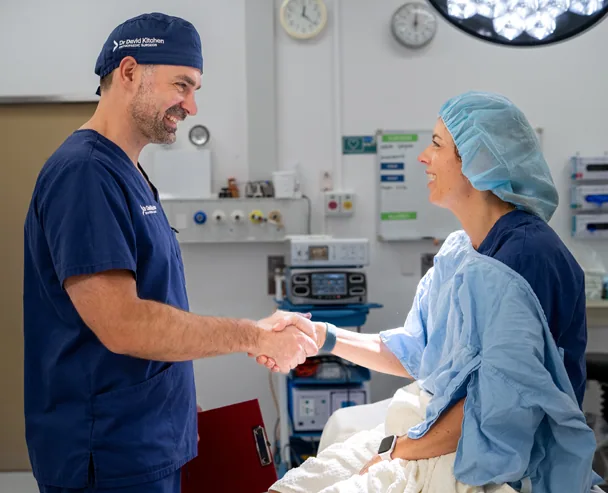
What is lower limb trauma?
Lower limb trauma ranges from fractures and dislocations to more complex injuries involving the joints, ligaments, and surrounding tissues of the hip, knee, or ankle. Injuries requiring orthopaedic management can include:
- Hip fractures, including fractures of the neck of femur, which are common after falls in older adults
- Acetabular fractures involving the socket of the hip joint
- Distal femur fractures above the knee
- Proximal tibia fractures below the knee
- Fractures around an existing hip or knee replacement, known as periprosthetic fractures
- Tibial shaft fractures
- Ankle fractures, including more complex bi-malleolar and tri-malleolar fractures
- Knee dislocations involving damage to more than one ligament
The treatment needed depends on the injury, fracture pattern, joint involvement, soft-tissue damage, circulation, and nerve function.
What to expect first after a lower limb injury
After significant lower limb trauma, the immediate priority is emergency care.
X-rays are generally used first to identify fractures and dislocations. A CT scan may then provide more detailed information about the fracture pattern, especially around joints such as the hip and knee, and to help with surgical planning if required.
The medical team will also assess blood supply and nerve function in the injured leg.
If there are concerns that circulation to the limb has been affected, urgent vascular assessment may be needed alongside orthopaedic care.
Do all hip, knee or ankle fractures need surgery?
Not every fracture requires an operation. The decision is based on the type and location of the fracture, how displaced or unstable it is, general health, and considering what non-surgical and surgical treatment will give the best chance of restoring function.
Significant fractures may be treated surgically to stabilise the bone and allow rehabilitation to begin. For older patients with fractures around the hip, surgery is usually recommended so mobilisation can begin sooner, as spending an extended period unable to move or bear weight can create additional health risks.
Dr Kitchen will consider the injury alongside your general health, level of activity before the accident and your goals when discussing treatment.
What does rehabilitation after lower limb trauma involve?
Recovery after a significant fracture or joint injury takes time and physiotherapy is an integral part of rehabilitation for regaining movement, strength and confidence with walking.
Rehabilitation begins in hospital and continues after discharge; the pace is shaped by the injury and the treatment performed. Early goals can include getting safely in and out of bed, using crutches or another walking aid and managing basic daily activities. As rehabilitation continues, it progresses to:
- Improving joint movement
- Rebuilding muscle strength
- Improving balance
- Increasing walking distance
- Returning to work and normal daily activities
- Gradually returning to recreation or sport where suitable
Pain, swelling and fatigue can change as activity increases, so recovery does not always progress in a straight line. It’s important to give yourself grace and maintain your efforts.
Can an injury cause arthritis later?
Injuries involving the joint surface itself can increase the risk of post-traumatic arthritis later.
When the smooth cartilage and underlying bone in a joint are damaged by an injury, the affected joint may over time become painful, stiff, or worn.
Regular orthopaedic follow-up after more complex joint injuries helps monitor healing and identify longer-term problems if they develop.
What happens if you fracture a leg around an existing hip or knee replacement?
A fracture around an existing joint replacement is called a periprosthetic fracture. These injuries are usually more complex, and treatment needs to consider both the broken bone and the existing implant.
Treatment may involve fixing the fracture around the joint replacement. If the implant has become loose or damaged, revision joint replacement might need to be considered.
This type of injury requires careful assessment of the fracture pattern, bone quality and stability of the existing hip or knee replacement.
When to ask for specialist orthopaedic referral
After the initial emergency assessment and treatment, specialist orthopaedic review may be recommended (or you can request it) if you have:
- A fracture, dislocation or significant joint injury
- Ongoing pain, swelling or restricted movement
- Difficulty walking or bearing weight
- An injury involving the hip, knee or ankle
- A displaced, unstable or complex fracture
- A fracture around an existing hip or knee replacement
- Concerns if surgery, immobilisation or structured rehabilitation is needed
Dr David Kitchen can assess lower limb trauma involving the hip, knee and ankle, review your imaging and discuss suitable treatment and a tailored rehabilitation plan. Your GP, emergency department or treating hospital team can arrange an orthopaedic referral.
If surgery was performed, Dr Kitchen will also assess follow-up imaging, monitor bone and joint healing, review movement and stability, and determine if further treatment or rehabilitation is needed.
Lower limb trauma FAQs
X-rays are commonly used first. CT scanning may be needed for more detailed assessment of complex fractures or injuries involving a joint.
There is no single recovery timeline. A straightforward fracture and a complex injury involving a joint or multiple structures can have very different rehabilitation requirements. Dr Kitchen and the team can give you a clearer timeframe more specific to you.
A fracture can occur around an existing joint replacement. These periprosthetic fractures require careful assessment because treatment may involve fracture fixation, implant revision, or both.
Orthopaedic assessment for lower limb trauma in Adelaide
If you have already received emergency treatment for a lower-limb injury and need ongoing orthopaedic assessment, speak with your GP or treating medical team about a referral to Dr David Kitchen.
Dr Kitchen consults privately at sportsmed Stepney and Henley Beach, as well as The Specialist Clinic Port Pirie.
*This article is for general information and educational purposes only. It is not a substitute for professional medical advice, diagnosis, or treatment, and does not establish a doctor-patient relationship. All surgical procedures carry risks and results vary between individuals. Consult with Dr David Kitchen MBBS MA (Cantab) BA Hons PhD FRACS FAOrthA (MED0001951664), Orthopaedic Specialist, for a personalised treatment plan.